SocioVerse Challenge 2026

In 2026, I serve as Program Chair of SocioVerse Challenge 2026, an AI4SS challenge on human–AI collaboration and social governance. The challenge brings large language models, agent-based social simulation, and social-science research into a shared research setting. Participants are asked not simply to demonstrate a model, but to formulate a meaningful research question, explain their study design, and deliver results that can be examined and reproduced.
Built around SocioVerse2, the challenge has three tracks covering reconstruction and forecasting, interventions and their effects, and innovations in research methods and systems. This page documents the research agenda, organizing institutions, participation options, and evaluation process.
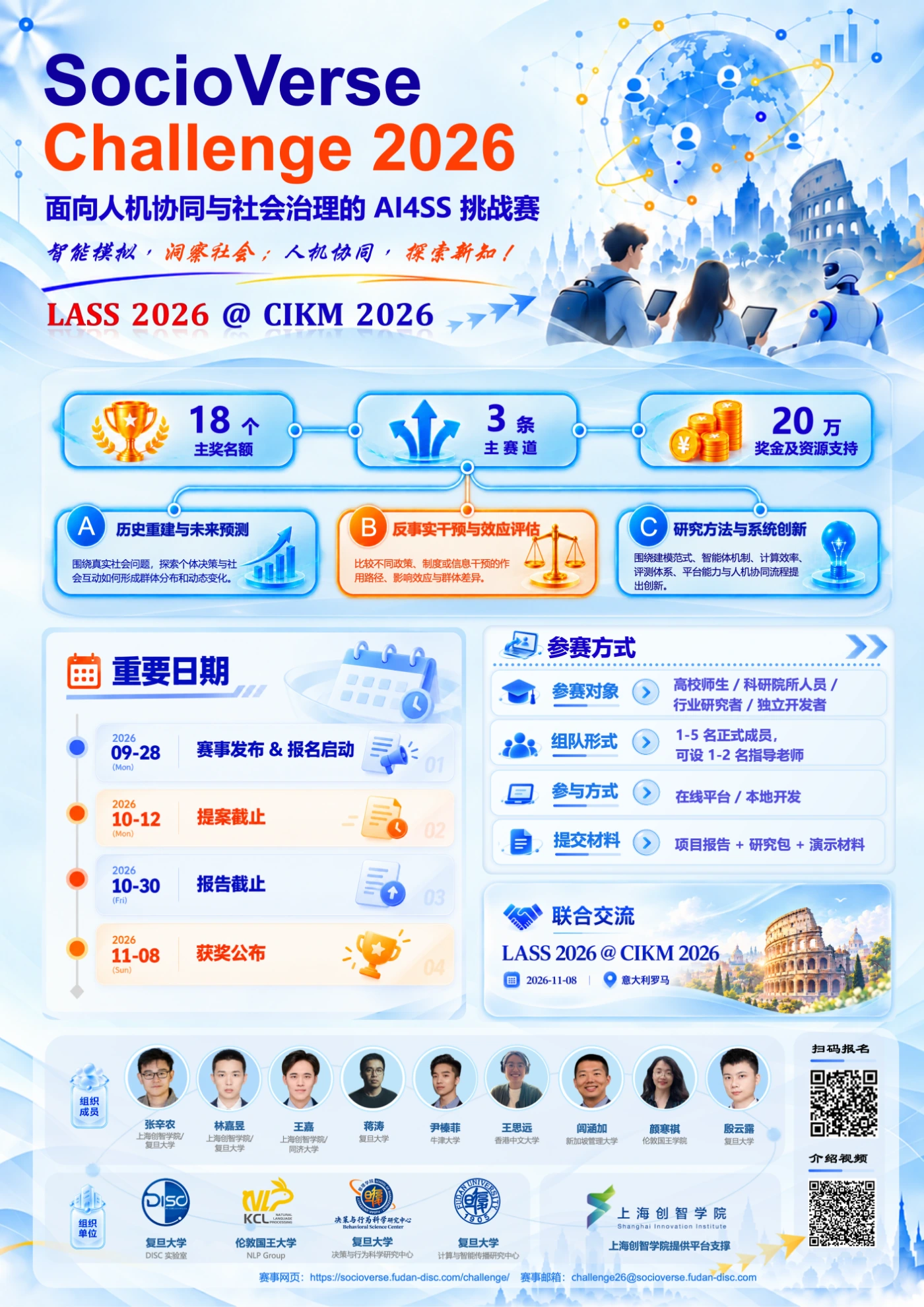
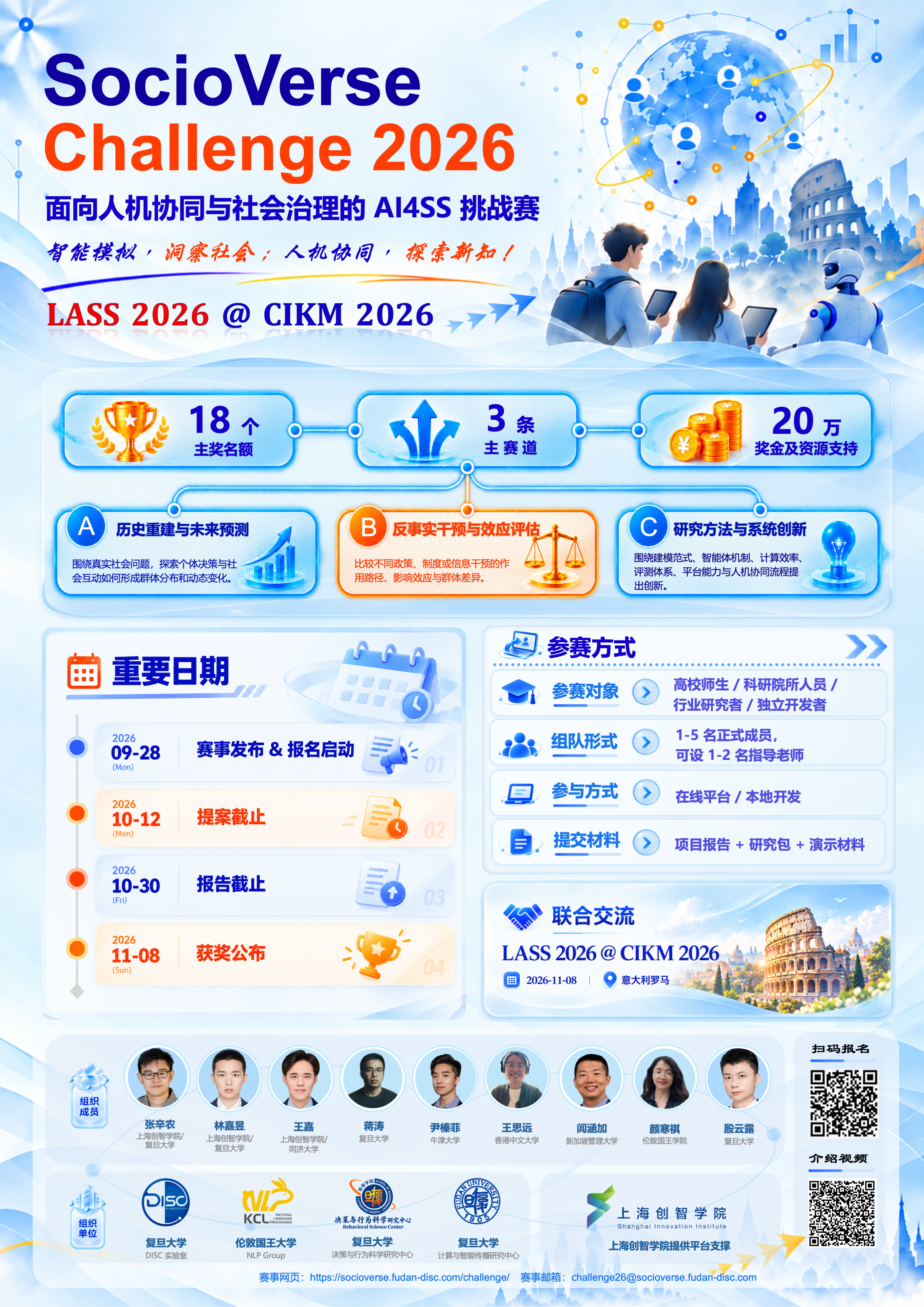
Official SocioVerse Challenge 2026 poster, retained as originally published. The schedule and award information below reflect the updated challenge website.
Open the high-resolution poster (2820 × 3988)
Research Agenda
AI4SS stands for AI for Social Science. This challenge asks how agent-based simulation can connect individual decisions, their environments, and interactions to the study of collective behavior, institutions, and social change.
SocioVerse2 organizes study settings around population (P), environment (E), and behavior (B). Participants need to explain who is being modeled, how data and environmental conditions are specified, how actions and interactions arise, and which results can be compared with observations. Platform examples span social media, urban housing, pharmaceutical procurement, and consumer confidence, among other domains. They offer starting points rather than prescribed tasks or conclusions.
The challenge therefore combines substantive research with technical implementation. A working simulation also needs an important question, explicit assumptions, and a clear account of the limits of its conclusions.
Organizers and Joint Exchange
The challenge is jointly organized by:
- The Data Intelligence and Social Computing Laboratory (Fudan DISC), Fudan University.
- The Natural Language Processing Group, King’s College London.
- The Behavioral Science Center, Fudan University.
- The Center for Computational and Intelligent Communication, Fudan University.
The Shanghai Innovation Institute provides platform support.
According to the challenge announcement, results will be exchanged jointly with LASS 2026 @ CIKM 2026. The 2nd Workshop on LLM Agents for Social Simulation is scheduled for November 8, 2026, in Rome, Italy, addressing agent modeling, simulation evaluation, safety and ethics, and scalable research infrastructure.
Three Research Tracks
A — Historical Reconstruction and Future Prediction
This track studies how individual decisions and social interactions produce collective distributions and changes over time. Projects may reconstruct an observed social process or examine forecasting performance. The central requirement is not merely a plausible-looking trajectory: researchers must specify the information available at each point in time, validate results against independent observations and suitable baselines, and identify errors across populations, locations, or periods.
B — Counterfactual Intervention and Impact Assessment
This track examines how changes in policies, institutions, information, or other interventions affect social outcomes through individual choices and interactions. Studies need comparable scenarios, an account of the mechanism, and attention to group differences and unintended effects. A simulated difference is not automatically a real-world causal effect; assumptions, robustness, and the scope of inference must remain explicit.
C — Methodological and Systems Innovation
This track focuses on research methods and tools, including modeling approaches, agent mechanisms, computational efficiency, evaluation, platform extensions, and human–system collaboration. A contribution may improve one component or extend the broader platform, but comparisons should establish its effectiveness, resource costs, and appropriate research settings.
Participation and Deliverables
The challenge welcomes university students and faculty, research-institute staff, industry researchers, and independent developers. Teams may have one to five formal members and one or two advisers. Each team chooses one subtask within one main track and submits a complete contribution.
Participants may use the online conversational workbench or develop locally. Both options share the same submission requirements and evaluation criteria. The online option uses platform-provided model credits; local development organizes the study and experiments within the open-source SocioVerse2 research environment.
Final submissions include a research report, a reproducible research package, and demonstration materials. Reports may be written in Chinese or English. The package must enable reviewers to follow and reproduce the experiment, with disclosure of models, random seeds, usage costs, and data conditions. Track C projects that modify the platform core also need the full code and execution instructions. Projects involving real individual-level data must address authorization, de-identification, and leakage risks.
Evaluation Process
The proposal stage determines eligibility for API funding; it does not eliminate teams. Teams without additional funding may continue. Final evaluation starts with reproducibility checks, followed by independent scoring by at least two reviewers, with a third reviewer added for substantial disagreement.
The website specifies five common dimensions, supplemented by track-specific considerations:
| Dimension | Weight | Focus |
|---|---|---|
| Social-science value and originality | 25% | Importance, substantive grounding, and novelty of the question |
| Methods and experimental design | 25% | Study settings, controls, ablations, and sensitivity analysis |
| Results and theoretical contribution | 20% | Evidential support and explanatory value |
| Reproducibility and engineering quality | 20% | Execution instructions, fixed seeds, and cost disclosure; a separate qualifying threshold applies |
| Presentation and future potential | 10% | Reporting, visualization, and opportunities for further work |
This combines research judgment with engineering checks. Producing an output does not establish a conclusion, while a worthwhile question still needs a sufficiently clear experiment and evidence to be assessed.
Awards and Research Support
Each of the three tracks awards one first prize, two second prizes, and three third prizes: 18 main awards in total. The current website specifies cash prizes in US dollars:
| Award | Teams per track | Prize per team |
|---|---|---|
| First prize | 1 | US$1,500 |
| Second prize | 2 | US$750 |
| Third prize | 3 | US$400 |
The main cash-prize pool is US$12,600**, with a separate **US$5,000 allocation for API and compute support. Compute credits are not cash prizes. The announcement specifies US$30 in initial credits per registered team and US$70 more after a proposal passes the funding review. Teams completing a submission receive written expert feedback, and outstanding work may be included among the platform examples.
The poster retains its original promotional figures. This text uses the current website’s currency and itemized awards, without converting or combining unlike categories.
Schedule
The schedule below was checked against the challenge website on October 13, 2026. Times are UTC+8.
| Date | Milestone |
|---|---|
| September 15, 2026 | Launch and registration opening recorded on the website |
| October 12, 2026, 23:59 | First-round proposal deadline |
| October 15, 2026 | Initial funding decisions |
| October 19 and 26, 2026 | Further proposal-funding review batches |
| October 31, 2026, 23:59 | Final submission deadline |
| November 1–7, 2026 | Reproducibility checks and expert review |
| November 8, 2026 | Scheduled awards announcement and ceremony; joint exchange with LASS |
The announcement permits registration and submissions after the first-round deadline, with further funding decisions on October 19 and 26. The proposal deadline is not the end of participation.
The original poster lists September 28 as the launch and October 30 as the report deadline. The current website lists September 15 for registration opening and October 31 for final submissions. The poster is preserved without changing its text; updated arrangements follow the official website.
Official Resources
This record draws on the official challenge website and poster. Schedules, awards, and submission rules may change; consult the challenge website for subsequent announcements.
