Generative Agents: Replication, Model Migration, and Legal RAG
Oct 3, 2026· ·
1 min read
·
1 min read
Dylan Chiang
This course implementation builds on Stanford Generative Agents. I adapted model services, configured a focused interaction scenario, and integrated legal-document retrieval into the existing agent workflow.
My extensions
- Model-service migration: Adapted chat calls to Volcengine/Doubao and handled its distinct multimodal embedding interface.
- Three-agent scenario: Configured roles, starting locations, and a meeting setup for focused interaction checks.
- Spatial consistency: Aligned scene regions, character spatial memory, and spawning locations.
- Document indexing: Added chunking, embedding calls, and document–vector mappings using JSON and NumPy.
- Retrieval integration: Implemented cosine-similarity Top-K retrieval and legal-keyword triggers that inject retrieved text into agent context.
- Integration records: Retained retrieval checks and dialogue records without equating functional integration with validated human-like behavior.
Architecture
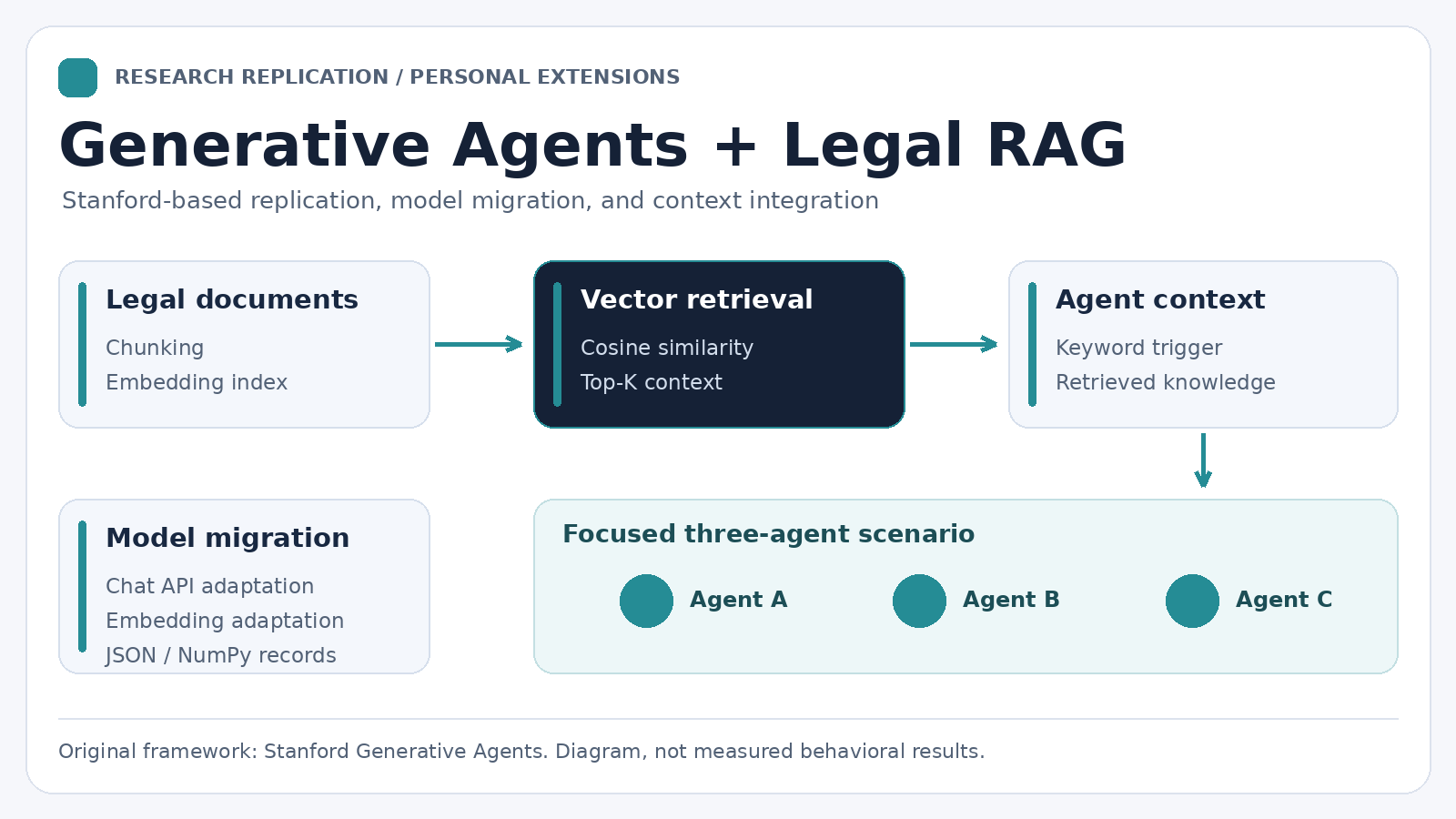
An implementation diagram, not an execution screenshot; upstream research and my integration work are distinguished.
Attribution and limits
The original framework and research belong to Stanford Generative Agents. My contribution is adaptation and integration, not invention of its memory, reflection, or planning mechanisms. No unmeasured improvement in answer quality is claimed.

Authors
Dylan Chiang
(he/him)
PhD Candidate in Intelligent Science and Technology, School of Data Science, Fudan University